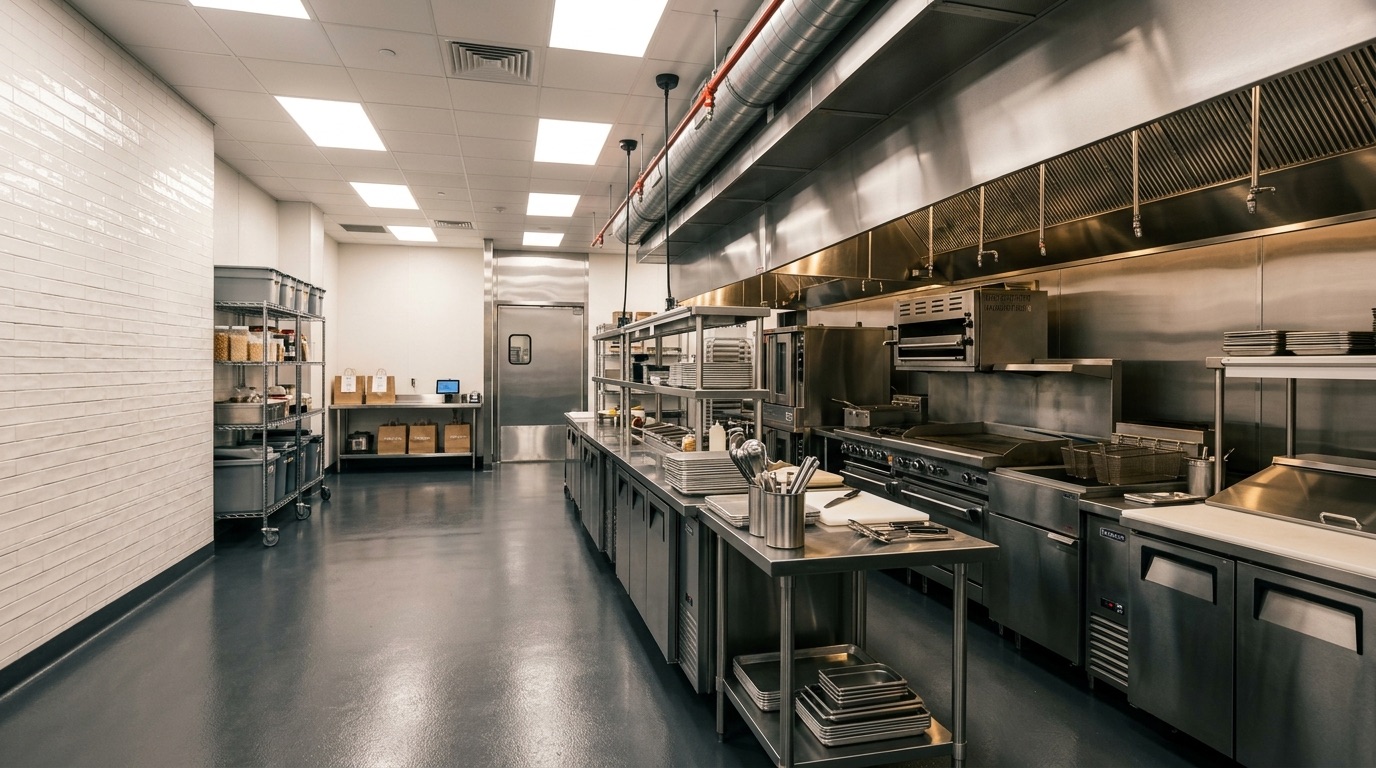
Build your ghost kitchen. Fund it fast.
Match with lenders who fund ghost kitchen buildouts, acquisitions, and multi-unit rollups from $50K to $1.5M — soft pull first, no credit impact.
Soft pull first — no credit impact. Takes about 2 minutes.
- NFPA 96 hood compliance
- Health department permits
- Third-party platform revenue
- Lease deposit financing
- Dark kitchens
- Virtual brands
- DoorDash / Uber Eats payouts
- Commissary kitchens
- Multi-unit rollups
Capital for every stage of your ghost kitchen.
From first buildout to multi-site rollup — funding sized to your delivery-first model.
- BuildoutGhost kitchen buildout loansFull project capital: hood, refrigeration, plumbing, electrical, and code compliance.
- AcquisitionGhost kitchen acquisition financingBuy a turnkey operating kitchen — underwritten on trailing cash flow, not projections.
- ExpansionCloud kitchen expansion fundingAdd your next site backed by the unit economics of the kitchens already producing.
- Soft pullNo credit impact to startSee lender matches and rate ranges before a hard pull ever hits your report.
- $50K–$1.5MLoan rangeBuildout to multi-unit rollup
- 2–4 weeksTypical close timeAcquisition: 30–60 days
- Soft-pull firstNo credit impactHard pull only when you choose a lender
How the capital moves.
Five steps, in order. One soft check. One hard pull, and only from the lender you pick.
Built for ghost kitchens.
Every lender on our panel understands delivery-only operations. They know what NFPA 96 hood compliance, health department permit timelines, and third-party platform payout statements look like before you start typing. Buildouts, acquisitions, expansions — all of them.
The lender pays us, not you.
When a matched lender funds your loan, they pay Ghost Kitchen Buildout Loans a flat referral fee. It is disclosed on every term sheet. It does not change your APR. Lenders compete on rate and approval speed, not commission.
One hard pull.
Only after you pick a lender. Until then it is a soft match: lenders see your file, you see their offers, and your credit report stays untouched. First draw released after lender sign-off. No in-person closings.
Banks weren't built for ghost kitchens.
Your delivery-first concept is real. The problem is that most bank forms weren't designed for commercial kitchens without a dining room. Three structural reasons banks decline working ghost kitchen operators — none of them about whether you can repay.
No dining room, no collateral they recognize.
Traditional restaurant lenders underwrite to front-of-house revenue and real-estate-anchored buildouts. A ghost kitchen — even one doing $1M in annual delivery revenue — doesn't fit the collateral model they were built for.
Projections, not history.
SBA-7(a) and traditional restaurant lenders want two to five years of operating history. A new ghost kitchen buildout has projections and platform benchmarks — not a trailing P&L. The paperwork doesn't fit their underwriting queue.
SBA timelines kill buildout schedules.
SBA-7(a) approval routinely takes 60 to 90 days. A signed lease starts the rent clock on day one. Operators who miss their buildout window lose the location and the capital they've already deployed.
What a funded ghost kitchen project looks like.
Composite illustrative scenarios — not specific borrowers. Each card is built from the kinds of buildout, acquisition, and expansion requests our intake routinely sees.
First-time ghost kitchen operator
Full buildout from vacant shell: NFPA 96 hood and fire suppression, three-compartment sink, refrigeration, POS hardware, and electrical rough-in. Bank declined on no operating history; equipment lender funded on the signed lease and contractor scope.
Multi-unit restaurant entrepreneur
Turnkey acquisition of an operating ghost kitchen — equipment, lease assignment, and third-party platform listings. Underwritten on trailing-12-month Uber Eats and DoorDash payout statements.
Ghost kitchen network, 3 sites
Adding a fourth site inside a shared cloud kitchen facility. Loan sized against the unit economics of the existing three-site portfolio. First draw released at lease signing.
Delivery-only operator, 2 brands
Bridge funding during a platform commission dispute that froze 60 days of payout. Alternative business lender funded in 72 hours against prior payout volume history.
Common questions
What does a ghost kitchen buildout loan cover?
A buildout loan funds the full kitchen: hood and fire suppression to NFPA 96, refrigeration, prep stations, three-compartment sinks, POS hardware, plumbing rough-in, electrical, and the general contractor scope. Most lenders include the lease deposit and first-month rent when they are part of the buildout package.
How much does a ghost kitchen buildout actually cost?
Typical buildouts run $80,000 on the leanest end (single-brand, shared commissary) to $750,000 or more (multi-brand flagship from a vacant shell). Loans through our network cover the $50,000-to-$1,500,000 range, with acquisitions and multi-unit deals reaching the higher end.
Will lenders fund a first-time ghost kitchen operator?
Yes — lenders in our network underwrite first-time operators when there is documented restaurant experience, a clear lease, and a contractor scope. Newer operators usually price 100-to-300 basis points higher than established multi-unit operators and may need a personal guarantee.
How long does buildout financing take to close?
Standard close is 2 to 4 weeks from soft-pull preview to first draw. Equipment lenders close faster than SBA-7(a) — which routinely takes 60 to 90 days — because they underwrite to the kitchen as collateral rather than 5-year cash flow projections.
Does the soft-pull preview affect my credit score?
No — the match preview uses a soft credit pull with no impact to your score. A hard pull only happens when you sign with the specific lender you select.
Why is this better than an SBA-7(a) loan?
SBA-7(a) often takes 60 to 90 days and treats ghost kitchens as untested collateral, which can produce a "no" after months of underwriting. Equipment and alternative business lenders comfortable with the model can close in 2 to 4 weeks because they underwrite to projected delivery-channel revenue, which third-party platforms publish category benchmarks for.